
Transcript
Announcer:
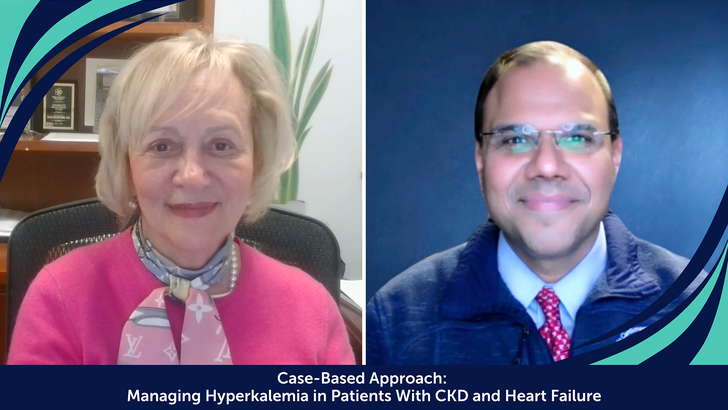
Welcome to CE on ReachMD. This activity, titled “Case-Based Approach: Managing Hyperkalemia in Patients With CKD and Heart Failure” is provided by Medtelligence.
Prior to beginning the activity, please be sure to review the faculty and commercial support disclosure statements as well as the learning objectives.
Dr. Kelepouris:
Despite the fact that GDMT is recommended for patients with chronic kidney disease and heart failure, providers often fear the effects of hyperkalemia and do not maximize treatment. Join us today as we review the evidence demonstrating the effectiveness of potassium binders in this patient population.
This is CE on ReachMD, and I'm Dr. Ellie Kelepouris.
Dr. Desai:
Hi. My name is Nihar Desai. I'm a cardiologist at the Yale School of Medicine in New Haven, Connecticut. It's great to be with you.
Dr. Kelepouris:
Thanks for being with us, Nihar. I want to begin with a patient case that really gets to the heart of this issue of treating these patients who may be at risk for or already have hyperkalemia.
And the patient is a 45-year-old woman with chronic kidney disease and heart failure. She has an eGFR of less than 40 mL/min, and she's categorized as CKD stage 3b, which means she also has proteinuria, albuminuria, as well as a reduction in her eGFR. Her heart failure stage is New York Heart Association II/IV. And she comes to see me with a lot of concern about the situation, that she has heart failure, she has chronic kidney disease.
And I think we should start by really highlighting the disease burden in this patient population of CKD and heart failure. So CKD prevalence, we know, has more than doubled since 1990, with 788 million adults affected by CKD, and it's really highlighting a significant global health challenge. The disease is a major contributor to cardiovascular mortality. I know you've seen patients like this, Nihar, and it accounts for 11.5% of global cardiovascular deaths, underscoring the need for improved CKD management.
Dr. Desai:
Yeah, thanks so much, Ellie. It's great to be with you, and this is such an important discussion. And as you know, it comes up for us literally every day in our practice.
I think a couple of things I might say, just to kind of reinforce the great comments that you kind of offered, that we have this incredible rise in the prevalence of heart failure, of chronic kidney disease, of metabolic diseases like diabetes. And the one thing that we know for all of those clinical conditions, many of which interact with each other, and we see that risk actually synergistically rises as patients have increasing numbers of those, that RAAS inhibitors really form the cornerstone for reducing cardiorenal risk in these patients. And yet we have to think about and then manage and deal with the hyperkalemia that often exists in the patients that we care for.
And so I think one important point I might reinforce for the audience is, while the prevalence of hyperkalemia might be quoted as 2% or 3% or 4%, that's not the prevalence of hyperkalemia that Ellie sees or that I see, especially when we're managing patients that have heart failure and CKD, like the one that, Ellie, you kind of referenced at the beginning here of this case discussion. There, the prevalence of hyperkalemia might be 12% or 15%, maybe as high as 20% depending on the degree of renal dysfunction. And so this really is a question that comes up all the time.
Dr. Kelepouris:
What we know is that chronic kidney disease is a major cardiovascular risk amplifier, and our patients with CKD die of heart-related complications, not of their underlying chronic kidney disease.
So I want to review the guidelines and the standard of care as I know them and really include you in the discussion. We know that the KDIGO 2024 Clinical Practice Guideline for the Evaluation and Management of Chronic Kidney Disease balances cardiovascular risk, renal protection, and potassium binders, emphasizing that hyperkalemia should not necessarily limit renin–angiotensin–aldosterone system inhibitor therapy. That's a really very important point that they made with KDIGO.
And the more important point is we are instructed and educated by KDIGO to not discontinue RAAS or MRAs but to initiate potassium binders and diuretics to enhance excretion of potassium so that patients remain on guideline-directed medical therapy. We know that GDMT really improves mortality and morbidity in these patients, so sticking to GDMT is really very important.
In addition to the KDIGO guidelines, the European guidelines have also educated us on some of the new strategies for the treatment of hyperkalemia, published in the European Journal of Internal Medicine recently, and they highlight, really, the importance of continuing GDMT with the addition, again, of potassium binders.
Adding binders to continue GDMT therapy and monitor to assess outcomes on mortality is really important in using this strategy.
Dr. Desai:
We have to recognize the risk of hyperkalemia, but we shouldn't be shying away from use of RAAS inhibitors. We should be using potassium binders to facilitate and enable highly effective RAAS inhibition.
I think the question, then, that sort of naturally comes up for all of us in our practices is, as you think about the different options for potassium binders that are available, what are some of the differences? How do we compare and contrast them? What do we know about potential differences between the binders that are available?
And I think the 2 that I might very quickly highlight—and I know we'll have some more discussion about this as well—is patiromer versus sodium zirconium cyclosilicate, or SZC. And both of these are modern potassium binders, but they have a very important difference in the mechanism of action.
So patiromer is a calcium–potassium exchange polymer versus SZC where there's a sodium–potassium exchange. In fact, for every 5 g of SZC, you get 400 mg of sodium. And so I think all of us, whether you're a primary care provider, whether you're a nephrologist or a cardiologist, had always wondered about, hey, does that sodium that's administered as part of SZC, does that have any important clinical implications?
And I will say, I'm very delighted to share a publication that we had that came out about a year ago in Kidney360, trying to do a comparison using real-world data and propensity score matching between patients receiving patiromer versus those receiving sodium zirconium cyclosilicate.
And one of the things that we observed was an increase in the risk of edema events and heart failure events in those patients getting sodium zirconium cyclosilicate relative to those getting patiromer. That was a signal that had been seen in smaller placebo-controlled trials of SZC versus placebo, again, where that sodium loading seemed to be associated with an increase in the risk of edema events or heart failure events in either the HARMONIZE program or in the PRIORITIZE-HF program. Now in our large real-world analysis, we saw a very similar finding.
Dr. Kelepouris:
I think it really points to the need for multidisciplinary care, right, which is really crucially important. How do we identify the right patient phenotype for the right pharmacologic intervention?
Dr. Desai:
And so I think your point is a really critical one, that talking to our colleagues across disciplines, really thinking about the different treatment options that we have available, and then trying to come together and define best practice for them and really applying the evidence and applying the therapies that we have to the patients we're caring for is really a critical part of this.
Dr. Kelepouris:
For those just tuning in, you're listening to CE on ReachMD. I'm Dr. Ellie Kelepouris, and here with me today is Dr. Nihar Desai. We're discussing the use of potassium binders for maintaining RAAS inhibition in patients with CKD and heart failure.
So let's look a little bit deeper into the evidence behind these potassium binders. Recently, there was a very large registry published. You and I worked on that registry. And it really was the Cardiovascular and Renal Treatment in Heart Failure Patients With Hyperkalemia or at High Risk for Hyperkalemia—the acronym is the CARE-HK in heart failure registry. It was published in the Journal of Cardiac Failure, and it was a very large non-interventional patient registry—2,500+ patients with HFrEF and a large cohort of patients that happened to also have advanced CKD, CKD stage 3b, GFR less than 40 mL/min.
What Stephen Greene and our other colleagues found, when we really analyzed the data, is that one-third of the patients with HFrEF were not adequately treated with RAASi or MRAs. We postulate that it's the fear of hyperkalemia, because the use of potassium binders was really low.
And the fear of hyperkalemia, I think, loomed large in the minds of the physicians who took care of these patients. We saw that hyperkalemia was recurrent. So when you get one hyperkalemic episode, you get many. And we also saw in this registry increased hospitalizations related to hyperkalemia.
The subanalysis was very interesting to me as a nephrologist, and I know that we're in the cardiorenal space, so interested in the cardiologist as well—65% of the cohort identified with eGFR less than 45 mL/min. Over a 2-year follow-up of this registry, what we noted was recurrent hyperkalemic events and only low adoption of potassium binders. So GDMT optimization also declined as CKD advanced from stage 3 to 4 to 5. So when our patients reached—well, the subjects reached stage 5 CKD, which is pre-dialysis, only 10% of patients were on guideline-directed medical therapy. And that's really a stunning statistic, right? Because we know GDMT keeps people out of the hospital, improves mortality/morbidity in our patients, and yet the agents that can prevent this from happening are not really being adopted by our colleagues.
And in fact, I think that the point that you made about identifying the right binder for the right patient, it really rings true here, that the patiromer versus SZC really differ in their binding mechanism of action and also in the counterion. Patiromer exchanges potassium for calcium and SZC for sodium.
And the sodium signal that you talked about really led to a label update by the European Medicines Agency, and there is some momentum around the medical positioning of patiromer, driven by the recent data and the EMA label update, to include worsening heart failure as an adverse event in the safety section due to edema.
Now, I think it's important to recognize that for every side effect, there may be a solution here, but choosing the right medication to treat the patient, I think, is really important.
And as you correctly pointed out, in a pooled analysis of 3 placebo-controlled clinical trials, SZC in non-dialysis patients and patients with preexisting heart failure, they experienced worsening heart failure, which occurred at a frequency of almost 13% for SZC compared to placebo. So it is something that we really need to be very aware of.
Dr. Desai:
Yeah, Ellie, that's been a really interesting kind of area, and we've had some new data kind of read out in that area as well. And I think the first one that I think deserves some mention is the REALIZE-K clinical trial. That was presented at the American Heart Association meeting in 2024 and was published in JACC in early 2025, and that trial looked at SZC for enabling or maintaining the use of spironolactone in patients with reduced ejection fraction heart failure.
So all those patients, of course, have a class I indication for MRA. We know and we've learned and appreciated the incredible benefits of MRAs and spironolactone for those patients.
And so what was done in REALIZE-K was there was a run-in period where everybody was getting up-titrated on spironolactone, SZC was being used in the background to support that up-titration and initiation, and then at the point of randomization, some patients continued on SZC; others withdrew the SZC. Of course, they would develop hyperkalemia and not be able to maintain or continue their spironolactone. That was observed, of course, probably to no one's surprise.
But one of the things that were seen, then, was some of the safety events from REALIZE, and there was a significant increase in cardiac failure serious adverse events.
And in addition, despite those patients who were receiving SZC and maintaining their spironolactone dosing, there was a numerical increase in natriuretic peptides, and that was a very unusual finding, certainly not something you would expect for patients with reduced EF who were having up-titration of their MRAs.
And when you couple that with the safety events that were reported in REALIZE with, again, an increase in hospitalizations for heart failure, that certainly adds yet another datapoint to this story. And also, I think, puts the EMA label update that you nicely kind of reviewed in some further context.
I think maybe the final bookend piece of data to consider is from the same trial but for patiromer. So not REALIZE-K that we just talked about, but the DIAMOND study. There was an NT-proBNP subanalysis from that trial, and it looked like in the patiromer-treated patients, there were significant reductions in NT-proBNP at week 18, consistent with what we have seen in other trials and other studies, and what you would expect as patients are getting up-titrated and escalated on neurohormonal therapy. On really good GDMT for the reduced EF heart failure, you'd like to see a commensurate decline in natriuretic peptides. And so that, again, seems to be another point of differentiation between what we've seen with sodium zirconium cyclosilicate versus patiromer in these 2 studies.
Dr. Kelepouris:
So before we wrap up, let's each offer a final take-home message to our audience. So what do you hope our listeners will leave with today, Nihar?
Dr. Desai:
If I could make just a few kind of summary points, I would say, first, that we still have real underuse and undertreatment of important comorbidities. We're not using RAAS inhibitors, ACE inhibitors, ARBs, mineralocorticoid receptor antagonists the way that we should be for many of the patients that we are caring for. That hyperkalemia, while common, now can be managed with the use of potassium binders. That's really where the guidelines are going. That's really where the evidence has gone. So stop discontinuing your RAAS blockade. Reach for one of the binders to help enable and facilitate the RAAS blockade, because we know the effects and how important they are for patients with heart failure and CKD and diabetes. And so I think maybe one key message is we've got to stick to the RAAS inhibitors, do all the things that we can do, including potassium binder use, to facilitate and enable RAAS blockade.
Dr. Kelepouris:
It's an exciting time to be a nephrologist and collaborate with cardiologists, because we have really revolutionized the treatment of chronic kidney disease, as well as cardiovascular disease, by the use of these agents, the pillars of care that George Bakris so eloquently described before his passing.
So that's all the time we have today, Nihar. Thank you so much. And thank our audience for listening and thank you for joining me in this discussion. It was very enjoyable.
Dr. Desai:
Thanks so much, Ellie, it was great to be with you.
Dr. Kelepouris:
Thank you, Nihar.
Announcer:
You have been listening to CE on ReachMD. This activity is provided by Medtelligence.
To receive your free CE credit, or to download this activity, go to ReachMD.com/CME. Thank you for listening.


 Global Learning Collaborative (GLC) has been authorized by the American Academy of PAs (AAPA) to award AAPA Category 1 CME credit(s) for activities planned in accordance with AAPA CME Criteria. This activity is designated for 0.25 AAPA Category 1 CME credit(s). Approval is valid until
